
By Dr. David O’Hare
Episode 1: the inhalation / exhalation ratio
Every month I run follow-up webinars to collect questions and offer my answers about cardiac coherence. I also receive many questions during my training courses, whether online, remote or in person.
Of all the questions about personal cardiac coherence practice, those about the various options for breathing frequencies and for inhalation and exhalation durations are by far the most frequent. As if there were some confusion or complexity around these notions.
From time to time we also see proposals for a “new cardiac coherence”, with variants that are sometimes fanciful, or extra options added to ever more numerous breathing guides.
I would like to take stock here, and it will take several episodes…
A reminder of the fundamentals
The notion of heart rate variability
In the natural state, in all vertebrates, the heart rate fluctuates with the environment, perceptions, emotions, situations and perceived risks, as an automatic and involuntary mode of adaptation. This is under the control of the autonomic nervous system. “Autonomic” means independent of the will.
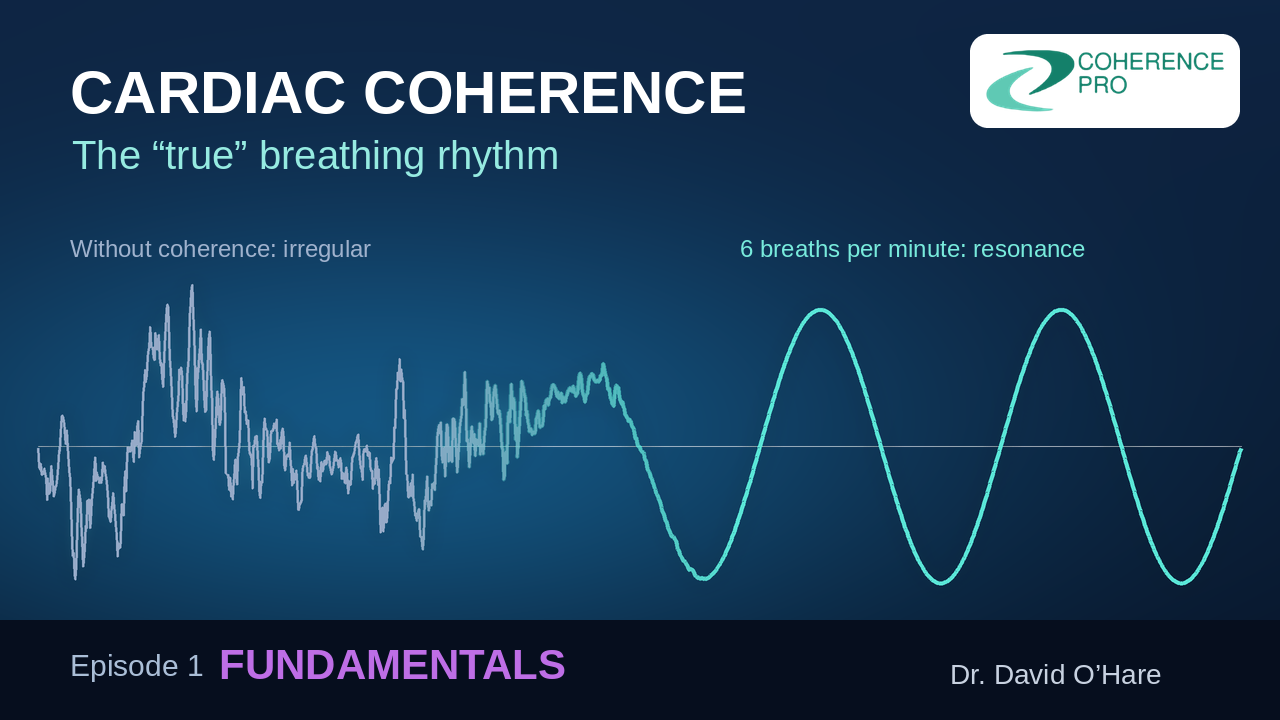
In the natural state, the heart rate fluctuates in an apparently chaotic way: that is, neither coherent, nor regular, nor periodic.
Definition of cardiac coherence
The physiological definition of coherence is a periodic fluctuation of the heart rate. This definition is based on the original, historical observation of a sinusoidal-looking curve of the heart rate fluctuation over time.
The accelerations and decelerations of the heart rate then occur periodically: the acceleration time and the deceleration time of the heart rate follow one another at constant (periodic) intervals.
The state of cardiac coherence can only be defined precisely with biofeedback equipment that displays the time analysis of the heart rate as it runs.
The role of breathing
Breathing influences the heart rate. This is called respiratory sinus arrhythmia (RSA), demonstrated in the 19th century and confirmed since by electrocardiography.
Inhalation speeds up the heart rate by activating the sympathetic nervous system and inhibiting the parasympathetic nervous system. Exhalation slows the heart rate through the opposite effect: activation of the parasympathetic nervous system and inhibition of the sympathetic system.
Any voluntary breathing in which inhalation and exhalation last equally long therefore equalizes the acceleration and deceleration times of the heart rate, through the action of RSA. A so-called cardiac coherence curve, with its characteristic sinusoidal periodicity, is then immediately observed.
When you equalize the time of inhalation and exhalation, a physiological state of cardiac coherence sets in or, as I prefer to say, a state of cardio-respiratory coherence. It is a reflex: automatic and systematic. This reflex is called the baroreflex.
Conclusion of the first part
Every time you voluntarily inhale and exhale for equal durations (whatever those durations are), you will be in a state of cardiac coherence. It is automatic; it is a reflex.
To be continued, with the notion of resonance…
The author’s commitment
I undertake to publish nothing that is not backed by one or more scientifically recognized publications, validated by peer review and published in internationally recognized journals.
References
The basics of variability and cardiac coherence, an essential article:
- Chaitanya S, Datta A, Bhandari B, Sharma VK. Effect of Resonance Breathing on Heart Rate Variability and Cognitive Functions in Young Adults: A Randomised Controlled Study. Cureus. 2022 Feb 13;14(2):e22187. doi: 10.7759/cureus.22187. PMID: 35308668; PMCID: PMC8924557.
The first to publish on biofeedback:
- Lehrer PM, Gevirtz R. Heart rate variability biofeedback: how and why does it work? Front Psychol. 2014 Jul 21;5:756. doi: 10.3389/fpsyg.2014.00756. PMID: 25101026; PMCID: PMC4104929.
The “bible” of heart rate variability:
- Heart rate variability: standards of measurement, physiological interpretation and clinical use. Task Force of the European Society of Cardiology and the North American Society of Pacing and Electrophysiology. Circulation. 1996 Mar 1;93(5):1043-65. PMID: 8598068.
Leave a Reply