By Jean-Michel Schlupp, health trainer and consultant (patient education, psychophysiological approaches, cardiofeedback).
In my professional practice, particularly in therapeutic patient education and in hospital supportive care, I make extensive use of cardiac coherence and cardiofeedback.
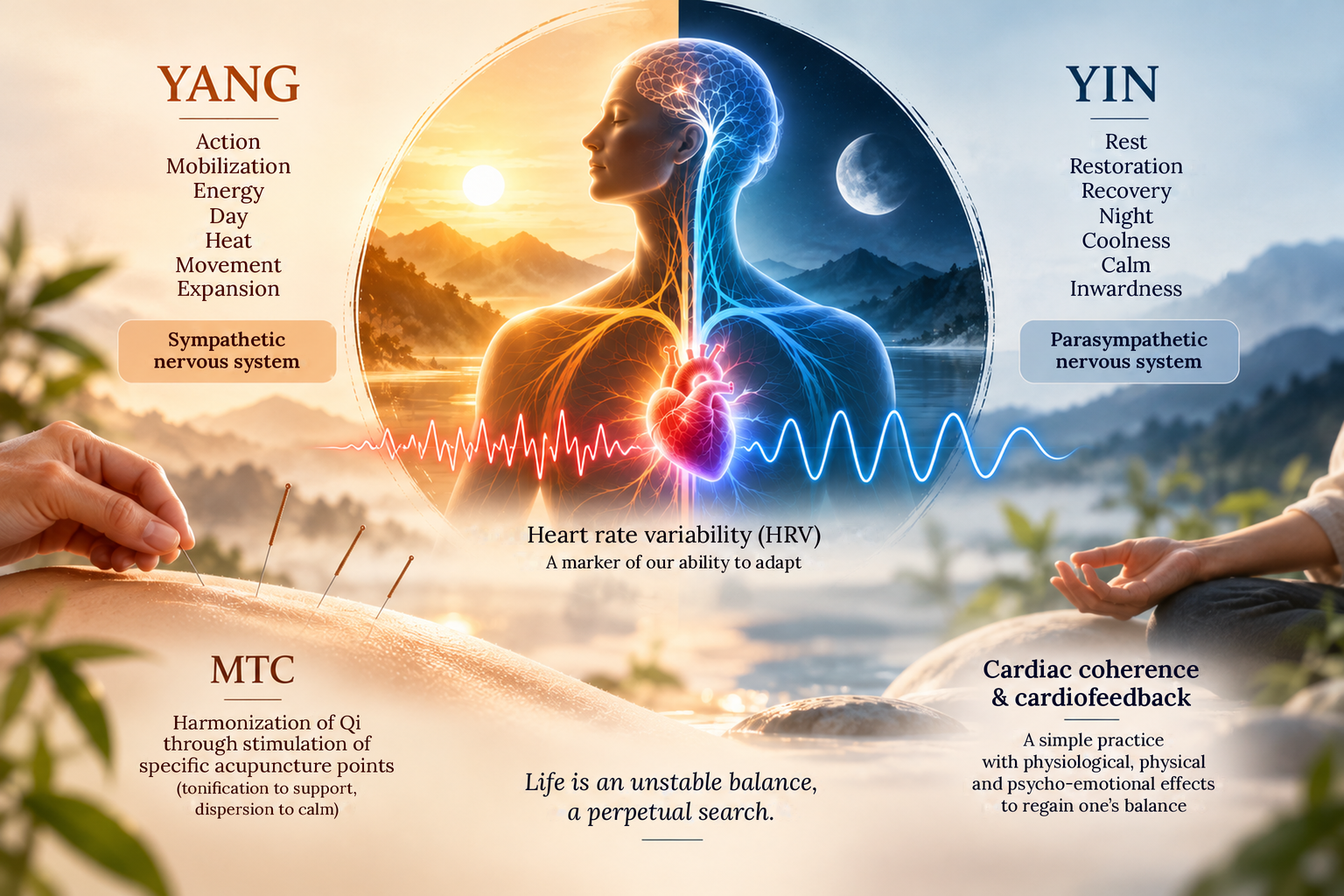
Alongside Dr. David O’Hare, I am especially interested in heart rate variability (HRV), a remarkable indicator of our ability to adapt.
But my background has another dimension that I rarely share: ethnomedicine, and in particular Traditional Chinese Medicine (TCM), which I studied for my university diploma in ethnomedicine.
For a long time, one parallel has fascinated me: the one between our autonomic nervous system and the dynamics of Yin and Yang.
☀️ The sympathetic nervous system prepares us for action, mobilizes our resources and promotes activity. It evokes Yang: movement, heat, daytime, expansion, the masculine, action.
🌙 The parasympathetic nervous system promotes rest, recovery and the restoration of our resources. It evokes Yin: calm, coolness, night, inwardness, the feminine.
Of course, these correspondences are symbolic. Yin and Yang are not anatomical structures, nor are they equivalents of our nervous systems.
But both approaches invite us to ask the same question: how does the body regain its capacity for regulation?
In TCM, the practitioner seeks to harmonize Qi, traditionally translated as “vital energy” or “breath” (one could even see a correspondence here with respiratory cardiac coherence!). Depending on the imbalances identified, the practitioner may seek to tonify (Bu), that is, to support or stimulate a function considered deficient, or to disperse (Xie), to reduce an excess and bring calm. The practitioner may also seek to release a stagnation of Qi. Contrary to a widespread misconception, the parasympathetic nervous system and Yin are more “powerful” than the sympathetic nervous system and Yang (sorry, gentlemen! 😉
So it is not simply a matter of stimulating one or calming the other, but of encouraging a harmonious circulation between the two.
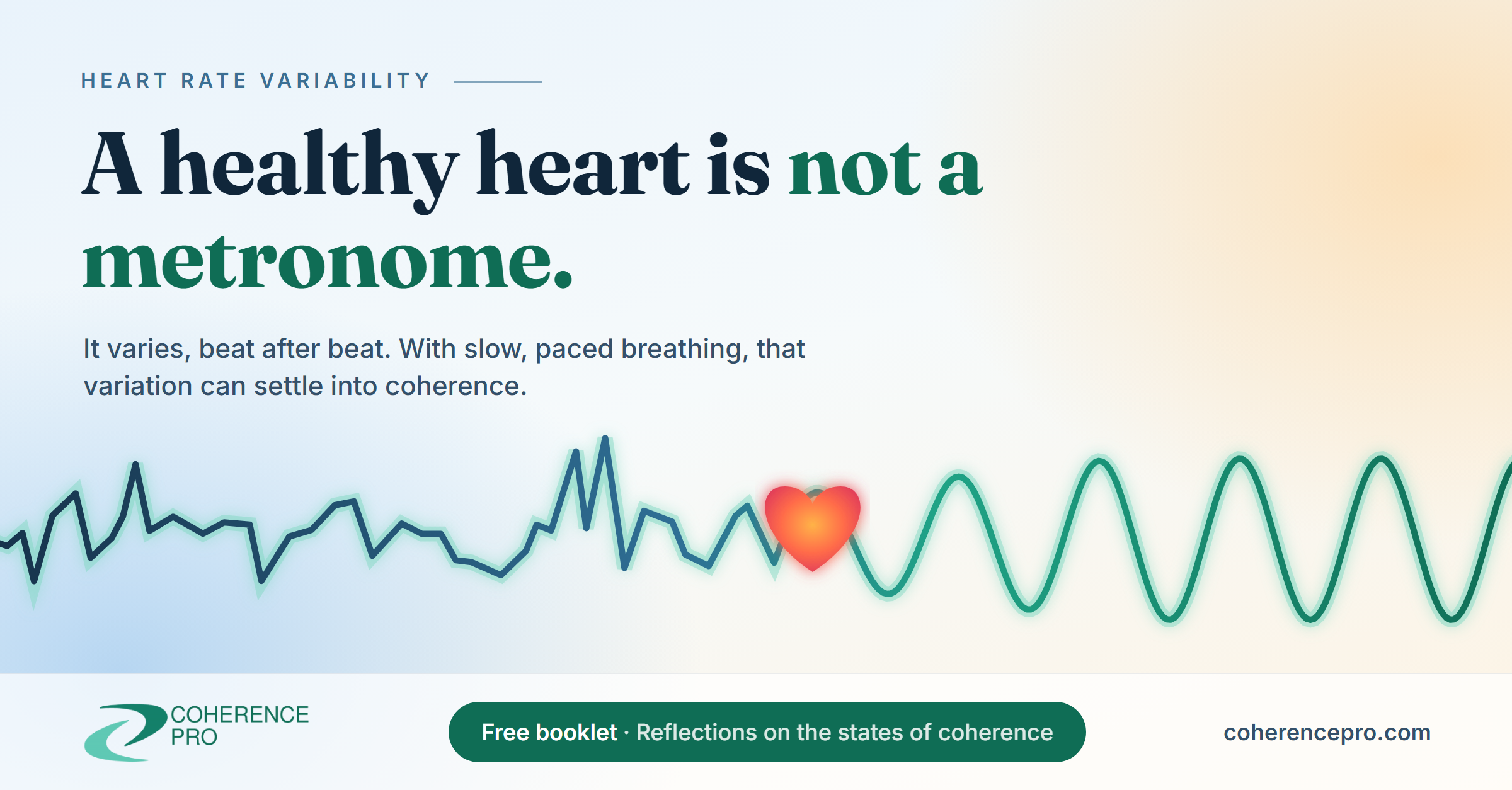
And isn’t that, in a way, what we are looking for with respiratory cardiac coherence? Through slow, regular breathing, we influence the interactions between the heart, the breath and the autonomic nervous system. There are of course other forms of cardiac coherence, less well known than respiratory cardiac coherence.
Physiologically, the state of cardiac coherence is characterized in particular by an increase in the amplitude of heart rate variability, linked to the baroreflex and vagal regulation, and by the appearance on the spectrogram of a very characteristic sinusoidal curve.
Physically and psycho-emotionally, the practice can, among other things, help release tension, bring calm, reduce perceived stress and improve emotional regulation.
These effects are documented in particular in the review by Zaccaro and colleagues (2018), published in Frontiers in Human Neuroscience. Other effects have also been documented, on the production of neurotransmitters, hormones, immunoglobulins and more.
This is precisely what interests me in supporting patients: enabling them to regain, through a simple and accessible practice, a degree of autonomy in regulating their physical and emotional states, within an integrative approach to care by a multidisciplinary hospital team.
And what about acupuncture?
A meta-analysis by Hamvas and colleagues (2023), published in Complementary Therapies in Medicine and covering nine randomized trials, suggests that acupuncture can change certain HRV indices, notably in the direction of parasympathetic modulation. The authors stress, however, that the results are heterogeneous and that further studies are needed. It is an interesting connection, even though an increase in HRV is not, on its own, proof of better health. It is nonetheless an extremely relevant indicator of our capacity to adapt, both physically and psycho-physiologically.
And then there is a wink that I particularly like…
In Chinese tradition, the number 365 has been symbolically associated with acupuncture points, echoing the days of the year.
365… like Dr. David O’Hare’s 3-6-5 method: 3 times a day, 6 breaths per minute, for 5 minutes. A coincidence, certainly, but one that I really enjoy!
Life is never still
After all, what brings these two views together is perhaps this fundamental idea: living things are never motionless.
In TCM, stagnation of Qi is regarded as a process of imbalance that, according to this traditional conception, can lead to functional disorders first and then to deeper, organic ones. In modern physiology, we also know that health depends on our ability to adapt, to mobilize our resources and then to recover. It is therefore not about being perpetually in action, nor about seeking permanent calm. Yang needs Yin. Action needs rest. Mobilization needs recovery.
As for the deep nature of Qi, it remains a notion specific to Chinese medical thought, with no physical equivalent directly established by modern science.
Finally, after all these years of practice and encounters with patients, one conviction grows stronger: life is an unstable balance, a perpetual search, an oscillation between complementary forces. A balance that was definitively fixed would no longer be the balance of living things.
What if health were not so much a state of balance as an ability, constantly renewed, to regain it?
References
- Zaccaro A. et al. (2018). How Breath-Control Can Change Your Life: A Systematic Review on Psycho-Physiological Correlates of Slow Breathing. Frontiers in Human Neuroscience. https://doi.org/10.3389/fnhum.2018.00353
- Hamvas S. et al. (2023). Acupuncture increases parasympathetic tone, modulating HRV: Systematic review and meta-analysis. Complementary Therapies in Medicine. https://doi.org/10.1016/j.ctim.2022.102905
Jean-Michel Schlupp is also the author of our series of reference sheets for practitioners, on stress, sleep, pain, emotions and more.
Follow us on LinkedIn for new posts on cardiac coherence.