
By Dr. David O’Hare
From a scientific point of view, cardiac coherence is a state of resonance. Some people even call it cardiac resonance or cardio-respiratory resonance.
What is resonance?
In physics, resonance is a phenomenon in which a system oscillates with a large amplitude under the effect of an external force applied at a well-defined frequency.
A classic example: if you push someone on a swing at the right moment, they go higher and higher. The swing has a natural oscillation frequency, and if you apply a force at that same frequency, resonance occurs and amplifies the movement.
Fluctuation = oscillation
The fluctuation of the heart rate discussed in the first episode is in fact an oscillation of the autonomic nervous system.
The sympathetic system, which speeds up the heart rate, and the parasympathetic system, which slows it down, work in alternation and produce a permanent oscillation.
A chaotic oscillation
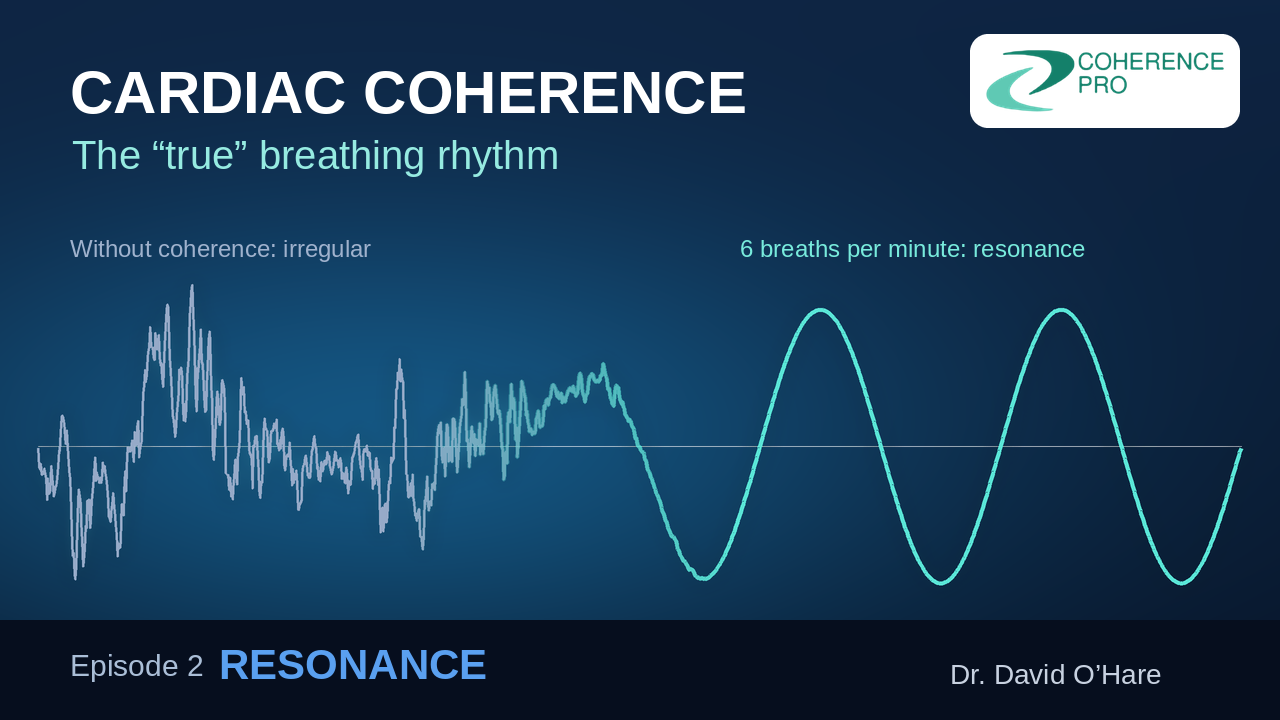
Without any voluntary intervention in breathing, this oscillation is irregular and chaotic, because it constantly adapts to the environment.
- Perception of a threat → fear → activation of the sympathetic system → the heart rate rises to mobilize energy for flight or fight.
- Perception of a return to calm → relief → activation of the parasympathetic system → switch to recovery, relaxation and restoration.
The environment being unpredictable, the adaptation is too, which makes the oscillation of the heart rate irregular.
Training the heart rate
The swing as a model
A swing oscillates best when the push applied matches its natural frequency exactly. A push that is too fast or too slow prevents the movement from being amplified.
Between sympathetic and parasympathetic, my heart swings.
The same goes for the heart rate: here breathing plays the role of the hand pushing the swing.
- Inhalation → the heart speeds up
- Exhalation → the heart slows down
In a mechanical oscillator such as a swing or a pendulum, the natural frequency is set by physical parameters. For example, pendulums with a long rod, like those of grandfather clocks, oscillate slowly, while the shorter ones of Swiss cuckoo clocks oscillate faster.
The natural frequency of the autonomic nervous system
The autonomic nervous system, which regulates the heart rate, works as an oscillator and has its own natural frequency.
In adults, this frequency is close to 0.10 Hz, or 6 oscillations per minute. When breathing is regulated at this rhythm, the oscillation of the heart rate reaches its maximum amplitude.
This frequency of 6 breathing cycles per minute is known as the resonance frequency, because it is the one that optimizes the cardiac oscillation, and it can be observed on an electrocardiogram.
The heart has its reasons… and its resonance 😉
Next: the notion of cardiac coherence…
← Previous: Episode 1: The inhalation / exhalation ratio
Leave a Reply