Description
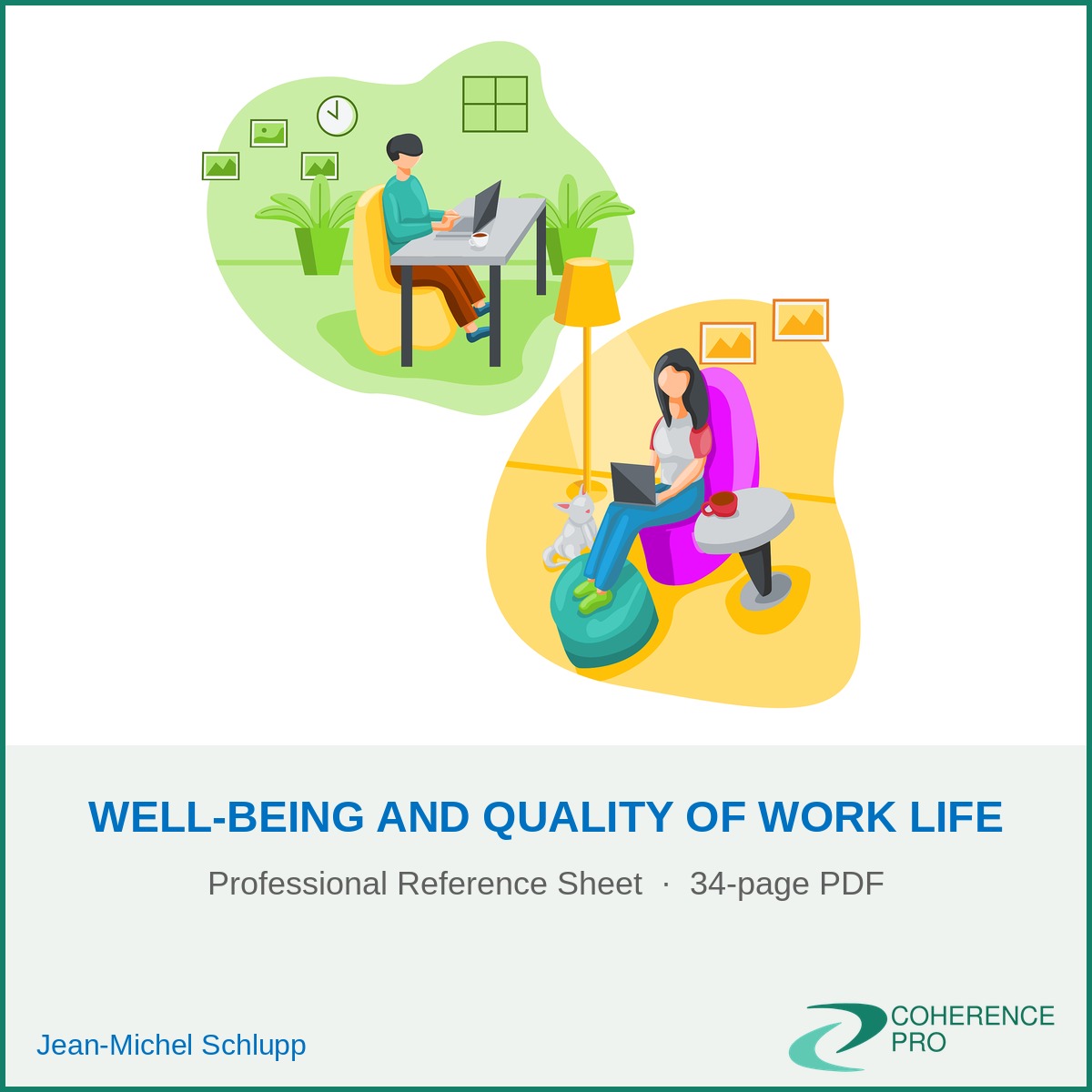
Well-Being and Quality of Work Life is a practical reference sheet for sophrologists, coaches, trainers, and consultants who intervene in companies and organizations. It is an original resource built from a compilation of data and years of professional practice, and it serves as a reference both for practitioners and for the people they support. Note that part of the legal framework presented (the 2013 national agreement, the Rebsamen law, psychosocial risks) is specific to France; it is explained for an international reader.
What’s included
- Clear definitions of well-being at work and Quality of Work Life (QWL)
- Ready-to-use breathing and body techniques for the workplace
- Tips for designing professional interventions
- A 34-page PDF
What’s inside
- The definition of well-being at work, its legal context, and the origins of QWL (human, social, and technical dimensions; American and European views)
- Psychosocial risks, and the scientific consensus on factors that support health
- Understanding stress: the resistance threshold, HRV, and tools to identify stress factors and reactions (Holmes and Rahe scale, HAD scale)
- Cardiac coherence at work, as an informal and a formal practice
- Breathing techniques: synchronized breathing with eye movements, cyclical breathing, 4-7-8, hippopotamus method, box breathing, paused diaphragmatic breathing, triangle breathing, projective breathing, and breathing with an anchor
- Tips for interventions in companies (workshop format and frequency) and body self-adjustment techniques to prioritize
How to use it
Hand the sheet to clients or participants, or use it to prepare workshops, lectures, and interventions in companies. It sums up well-being strategies in a clear, practical format. It supports an educational and preventive approach at every level (primary, secondary, and tertiary prevention) for physical and psychological well-being.
Who are the reference sheets for?
- Any professional in helping relationships, support, or health care
- In particular: sophrologists, sports coaches, adapted physical activity instructors, midwives, physiotherapists, and osteopaths
- Professionals who use breathing techniques or body-based induction techniques
- Clients and patients, as a summary document for health education
Format and access
Each sheet is complete and downloadable as a PDF. Access is immediate and unlimited from your personal account: download the document and use it freely in your practice, workshops, lectures, companies, or institutions. For professional and educational use. This document does not replace medical advice.
The Author: Jean-Michel Schlupp
 Health Practices and Environments Consultant – Teacher and Trainer
With more than ten years of clinical experience in hospital settings, notably in hospital supportive care, a European University Diploma in psychopathology, and several postgraduate trainings in health practices and environments, Jean-Michel Schlupp works with patients, health professionals, and organizations on therapeutic patient education, quality of care, prevention, and health environments.
His approach combines clinical practice, teaching, and attention to the systemic dimensions of care. Authorized to deliver therapeutic patient education programs, he teaches at nursing schools on therapeutic education and health prevention, and sits on the examination jury for this course unit. He is registered as an Occupational Risk Prevention Practitioner (IPRP) with DREETS, the French regional labor authority, specializing in the health sector.
Jean-Michel is the academic director and a teacher of the first European University Diploma dedicated to supportive care, alongside the renowned Dr. Mario Beauregard, a neuroscience researcher with whom he collaborates. He teaches at two nursing institutes and has trained more than 1,000 professionals in helping and care relationships, most of them sophrologists and licensed health professionals (nurses).
His work has been the subject of several evaluations of professional practice and three publications at medical congresses (the Francophone Society of Nephrology, Dialysis and Transplantation, SFNDT, and the German Society of Nephrology, DGfN).